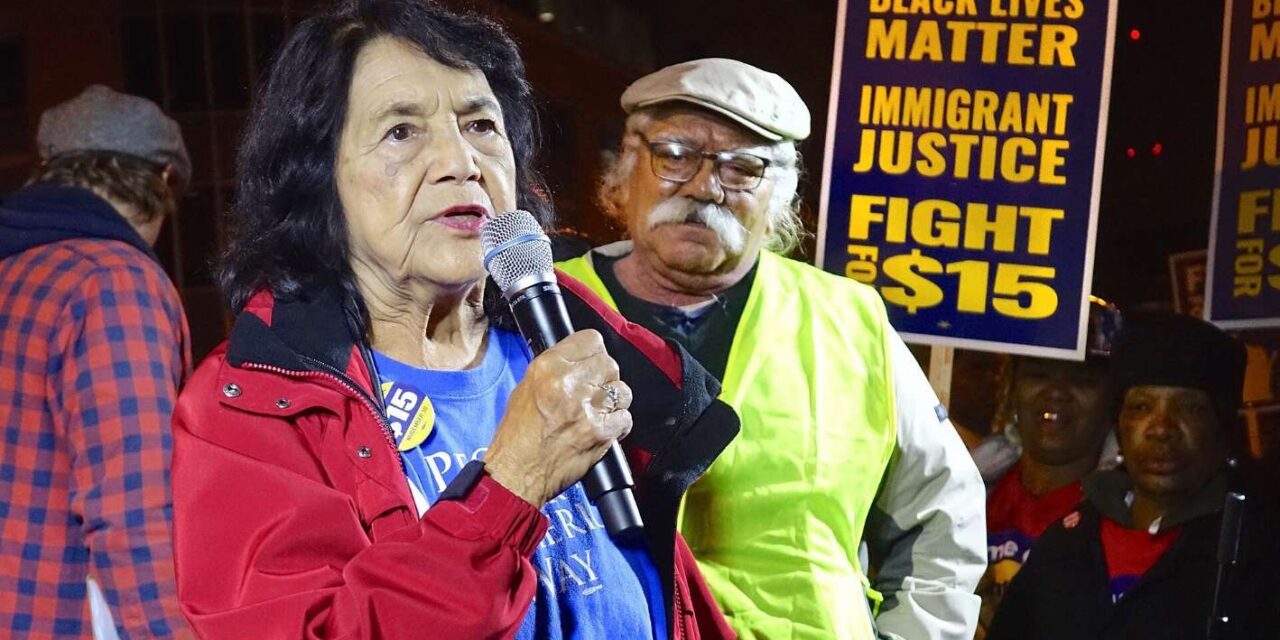
Dolores Huerta speaks at a rally in Milwaukee in 2015. (Photo: Susan Ruggles / Wikimedia Commons, CC BY 2.0)
SAN FRANCISCO — On Wednesday, people gathered in Balmy Alley in the Mission to remember Dolores Huerta. At Cesar Chavez Elementary School, a mural by Juana Alicia shows her cutting through a border fence. The woman who gave a movement the words “Sí, se puede” had died that morning at her home in Bakersfield. She was 96.
Huerta died of cancer, family spokesperson Eric Olvera said, the San Francisco Examiner reported. The family asked for privacy and said plans to celebrate her life would be shared later. Gov. Gavin Newsom ordered flags flown at half-staff across California.
Her work was for farmworkers. Her slogan traveled much farther, and the tributes that poured in Wednesday, from former President Barack Obama to the California Legislative Black Caucus, showed how far.
From Stockton to the Medal of Freedom
Huerta was born in New Mexico and raised in Stockton, where she earned an associate degree in teaching at San Joaquin Delta College. In the early 1960s, she and Cesar Chavez launched the National Farm Workers Association, which became the United Farm Workers.
She coined “Sí, se puede” — “Yes, we can” — during a 25-day fast Chavez led in the early 1970s in support of Arizona farmworkers. Muralist Juana Alicia credited her with influencing California’s Agricultural Labor Relations Act, signed in 1975, which gave farmworkers the right to organize and bargain collectively, the San Francisco Standard reported.
In 2012, President Barack Obama awarded her the Presidential Medal of Freedom. In her later years, her Bakersfield-based organization pushed for reproductive rights, LGBTQ equality and expanded voter registration.
She was still showing up in San Francisco this year. She backed Supervisor Myrna Melgar’s Clean Streets, Fair Wages Act, which the Board of Supervisors passed unanimously in September to protect street cleaners.
“Dolores got there first”
Tributes came from across the country Wednesday. The Bakersfield Californian collected dozens.
Former President Barack Obama and former first lady Michelle Obama said in a joint statement, “But as usual, Dolores got there first.”
Former Vice President Kamala Harris said, “Thanks to her, immigrants and workers won better wages, working conditions, environmental protections and voting rights.”
Assemblymember Isaac Bryan, vice chair of the California Legislative Black Caucus, said, “We mourn this loss but we carry her legacy and her ultimate message: Sí, se puede.”
Closer to home, Mayor Daniel Lurie said, “Dolores Huerta changed the lives of generations of San Franciscans and people across the country.” Rep. Nancy Pelosi said, “Dolores was a dear friend, and we all responded to her rallying cry, ‘Sí se puede.'”
Muralist Irene Pérez, whose group Mujeres Muralistas has painted the Mission since the 1970s, put it plainly. “She was standing for all of us,” Pérez said, the Standard reported.
A legacy told whole
Huerta’s final year also brought a hard truth into public view. In March, The New York Times published her account that Chavez sexually abused her and committed violence against her in the 1960s. Two other women also made allegations. Chavez died in 1993.
San Francisco is changing a name, too. City officials have begun the process of renaming Cesar Chavez Street as “Las Campesinas,” a proposal from a committee led by Assessor-Recorder Joaquin Torres.
“I see her passing as one final organizing moment, shaking us awake to what we know is important,” Torres said.
United Farm Workers President Teresa Romero said, “The greatest possible tribute to her life is for her work of organizing to continue.”
Five days before an election, that is not a eulogy. It is an assignment.
Huerta’s family has said plans for a celebration of her life will be announced later. The Sun-Reporter will share details when they are public.
This report draws on the San Francisco Examiner, the San Francisco Standard and The Bakersfield Californian.
Support 82 years of Black Bay Area journalism. Our stories are free to read. A $20-a-year subscription keeps them coming.