
By Dr. Julianne Malveaux
Have you ever heard Willie Brown speak? Before he utters a word, he has already made an entrance. He does not merely walk into a room; he arrives. Impeccably attired, often in the kind of Wilkes Bashford elegance that made San Francisco style its own political language, Brown speaks with his whole body. There is a strut in his cadence, a wink in his wisdom, and a mastery of timing that reminds us that power, when worn well, can be both strategic and stylish.
But Willie Brown’s style has never been merely sartorial. It is the style of a Black man who learned how to navigate power, command rooms that were not designed for him, and open doors through which others might pass. His swagger is not vanity. It is survival refined into art. It is confidence earned in hostile spaces. It is the audacity of a Black man who knew he belonged before others were prepared to admit it.
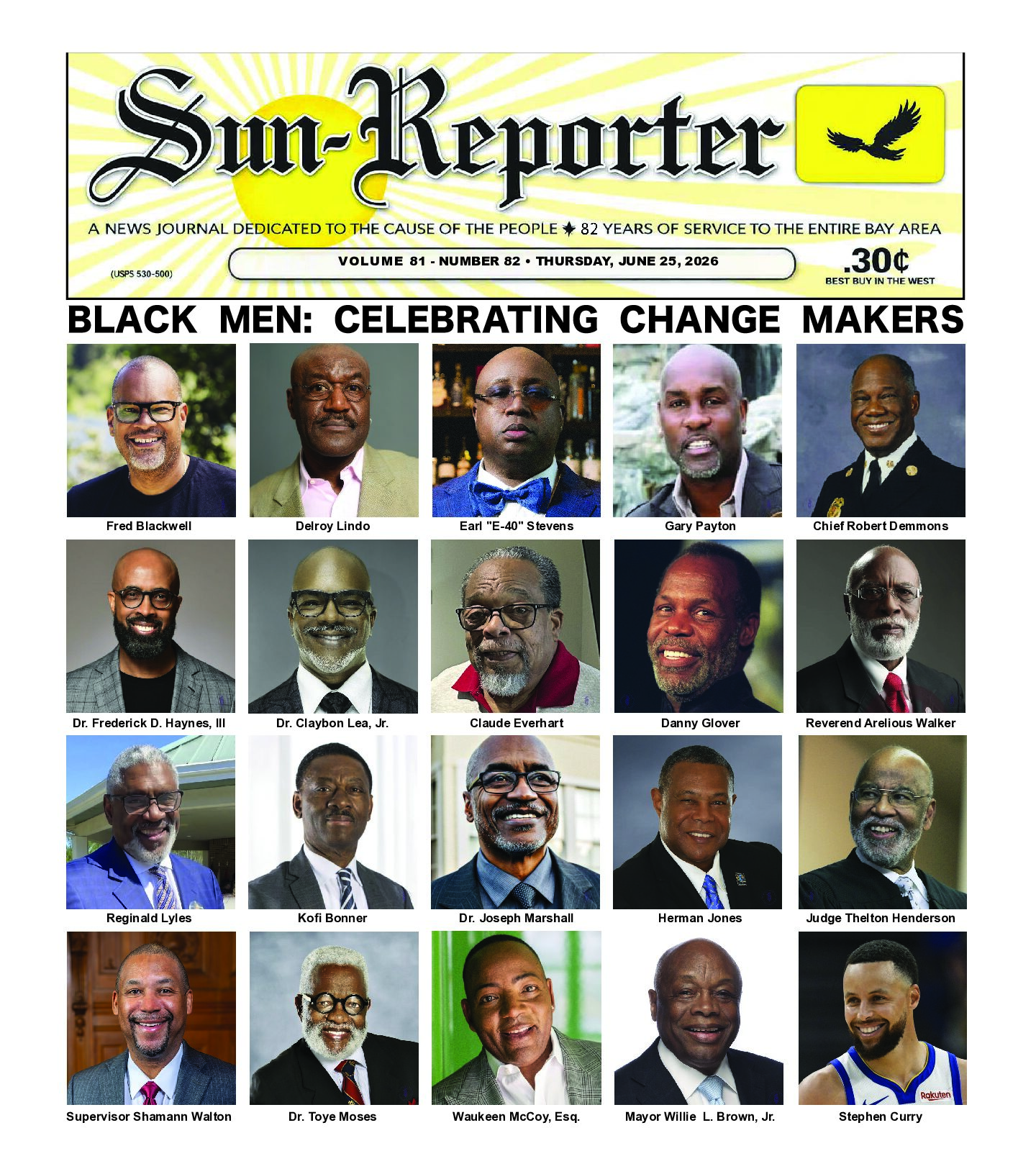
Yes, Willie has swag. More correctly, and most ebonically, Willie got swag. Swagger, at its best, is not arrogance. It is history, discipline, survival, joy, and service made visible. Sun-Reporter publisher Amelia Ashley-Ward has compiled a list of twenty Black men who either live in the Bay Area or have Bay Area roots. One way or another, they all have SWAG, and I was both delighted and challenged to write about them for this special issue. Delighted? I know some of these men personally and am proud to see them lifted. Challenged? How does one reduce the essence of Black manhood to a sentence, a paragraph, or even an acronym as straightforward as SWAG: style, wisdom, audacity, and grace?
I remember hearing Willie Brown speak years ago about California’s changing demographics. It was vintage Willie — funny, sharp, stylish, and just provocative enough. He told the room that we had better get ready for a new California, one where salsa might replace ketchup on the side of our eggs. People laughed, but some shifted in their seats, too. That was Willie: a one-liner could become a warning; a joke could become a forecast. He understood before many others did that California’s future would be multiracial, multicultural, and politically transformed. His one-liners were never merely jokes. They were political weather reports.
Rev. Dr. Frederick Douglass Haynes III — those of us who know him call him Freddy — carries the energy and passion of his iconic namesake. Freddy Haynes gives us the Black pulpit at full height: soaring rhetoric, moral clarity, scriptural fire, and a social-justice spine. A longtime friend, Rev. Haynes reminds me that preaching is not merely performance, but power; not simply inspiration, but a summons. His language is both balm and blade, comforting the wounded while cutting through hypocrisy. He stands in the prophetic tradition that insists faith must speak in public, love must confront injustice, and the Word must be made flesh in the streets. Now, as the Democratic nominee for Texas’s 30th Congressional District, he is poised to carry that prophetic voice into Congress.
Shamann Walton’s public life carries the arc of transformation: from juvenile hall to City Hall, from school board leadership to District 10 representation, from neighborhood advocacy to the presidency of the Board of Supervisors. As the first Black man elected to lead that body, and as a force behind San Francisco’s reparations process, Walton reminds us that Black male leadership is also about repair — repairing systems, repairing communities, and insisting that the city tell the truth about its past. At a Black to San Francisco event a couple of years ago, I watched him interact with HBCU students who participated in the program. A Morris Brown graduate, he understands how under-resourced HBCUs are and how transformative the Black to SF program was for our young people. He was present, attentive, and easy with them. That, too, is leadership: not just policy, but presence.
While all of these men have passion for our young people, Dr. Joseph Marshall made that passion an institution. He founded the Omega Boys Club, now Alive & Free, and turned grief over young lives lost into a San Francisco institution rooted in intervention, prevention, discipline, and love. Joe Marshall gives us grace as intervention: the grace of refusing to give up on young people whom society has already written off.
Dr. Toye Moses offers another kind of grace: the steady, patient work of community connection. He reminds us that Black male leadership is not always performed from a podium or spotlight. Sometimes it is built through family, faith, relationships, outreach, and the everyday architecture of community. The work of connecting people to opportunity, resources, and one another rarely gets the applause it deserves, but cities cannot hold together without it.
It takes grace to be a public servant, and it also takes audacity. One of my favorite Martin Luther King Jr. statements comes from his 1964 Nobel Peace Prize acceptance speech, when he said, “I have the audacity to believe.” Audacity. The nerve. The temerity to think beyond constraints. To take the road less traveled. Or to take a road well traveled and improve it for those who come behind you.
Bob Demmons, the first African American to lead the San Francisco Fire Department, certainly has audacity, resilience, and grace. He transformed the culture of the department, and he had the pure audacity to fight the powers that be and, with his able attorney Eva Jefferson Paterson, implement significant changes in the way a once-rigid institution operated. And to see Bob Demmons smile is to feel as if blessings have rained on you. With all the challenges he faced, he radiated joy.
Claude Everhart and I go back to Lowell High School, and I have watched his life trace an arc of commitment to San Francisco and its Black community. Claude represents the tradition of Black men who moved from movement work into civic service without losing their allegiance to the people. His leadership reminds us that access to power is not the same as purpose. Purpose is using whatever access one has to widen the circle for others. If there is background music to Claude’s work, it might be Sade’s “Smooth Operator” — not because the work was easy, but because he has often moved with steadiness, style, and quiet effectiveness.
Danny Glover is one of San Francisco’s proudest gifts to the world, an artist who never mistook applause for purpose. In him, we see an heir to Paul Robeson: a performer whose art is inseparable from conscience. Danny has used fame not as refuge from struggle, but as a platform for justice. His career reminds us that Black artistry can entertain, illuminate, disturb, organize, and heal. Working people sing his praises from Cuba to Venezuela to Haiti and beyond, places where his presence and his words have made a global difference.
And if San Francisco is going to lift Black men, we ought also to hear the music. John Handy, the brilliant saxophonist and composer, reminds us that Black male genius has a sound — improvisational, disciplined, daring, rooted, and free. His music belongs in this conversation because culture is not decoration. Culture is how a people remember themselves, steady themselves, and imagine what comes next.
To praise Black men is not to pretend that Black men are perfect. No human being is. It is to refuse a culture that too often discusses Black men only in the language of deficit — incarceration, absence, violence, unemployment, threat. Praise is not denial. Praise is correction. Praise is balance. Praise is love with evidence.
The men lifted in this issue are different in age, vocation, temperament, and style. Some lead from the pulpit, some from City Hall, some from classrooms, courtrooms, community organizations, stages, screens, firehouses, and streets. Some lead with a sermon, some with a saxophone, some with a lawsuit, some with a policy proposal, some with a basketball, some with a well-timed word, some with a steady hand on the shoulder of a young person who needs to know that he matters.
That is why SWAG matters. Style without wisdom is costume. Wisdom without audacity can become caution. Audacity without grace can become ego. Grace without style may be overlooked. But together — style, wisdom, audacity, and grace — these qualities help explain why Black men have continued to stand, build, teach, preach, govern, organize, perform, protect, and love in a country that has too often tried to diminish them.
Swagger, at its best, is not arrogance. It is history carried upright. It is discipline with rhythm, survival refined into art, joy refusing erasure, and service made visible. The Black men lifted in this issue have given us style, wisdom, audacity, and grace. They have given us SWAG. And in giving it, they have given us reason to stand a little taller ourselves.
Support 82 years of Black Bay Area journalism. Every story, editorial and Community Voice piece — $20 a year.