
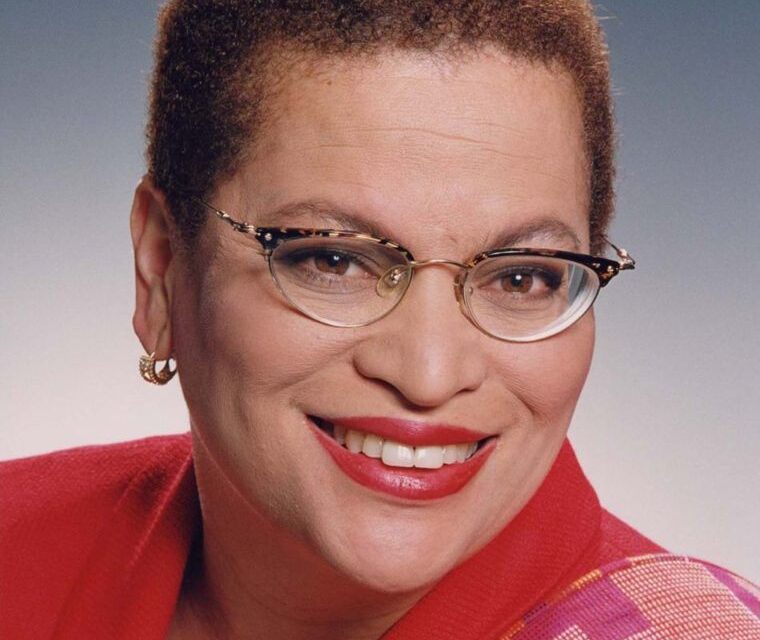
By Dr. Julianne Malveaux
Editorial
Throwing a rock and hiding your hand. It is an old expression for provoking trouble while avoiding responsibility for the consequences. It belongs in the conversation about San Francisco’s District 10 election, where billionaire money and mayoral ambition meet under the comforting language of neighborhood progress.
Mayor Daniel Lurie needs to put his political intentions on the table.
In July, Lurie said he had “no plans” to endorse in the District 10 race. On September 11, he endorsed Theo Ellington. A mayor can change his mind. Residents can ask what changed it—and what the mayor expects from the person he wants them to elect.
The endorsement followed cryptocurrency billionaire Chris Larsen’s extraordinary $500,000 contribution to an outside committee supporting Ellington. That contribution has since grown to $540,000. According to San Francisco’s Ethics Commission, Larsen supplied more than 98 percent of the committee’s $550,000 in reported contributions.
The committee calls itself “From the Neighborhood, for the City.”
When I hear “neighborhood,” I think of lumpia, fried chicken gatherings and kids selling candy door to door. That is the energy of my Bernal Heights roots: neighbors gathering singles, tens and twenties to boost a native son, passing the hat and coming together.
I do not think of one rich man supplying almost every dollar to an outside political committee. The name suggests a neighborhood effort. The disclosure shows a billionaire bankrolling it.
Larsen has been unusually clear about his preference. He described Ellington as “cut from the same cloth” as Lurie and said he expected Ellington to work with the mayor rather than “sabotage” him. Larsen has also supported Lurie’s initiatives with millions of dollars.
Sabotage is a revealing word. A supervisor who questions a mayor’s priorities is performing a public duty. A supervisor who demands protections for residents before approving a development is exercising judgment. A supervisor who refuses to fall in line may be doing precisely what constituents elected that person to do.
The mayor’s convenience is a poor measure of a supervisor’s worth.
District 10 is choosing its representative. Lurie’s endorsement and Larsen’s financial support raise an unavoidable question: How much of this campaign is about serving the district, and how much is about securing another dependable vote for the mayor?
That question deserves an answer from Lurie himself.
The mayor’s endorsement praised Ellington’s ability to advance affordable housing, prevent displacement and create economic opportunity. These are worthy goals. They are also familiar campaign promises. Residents need to know what they mean in practice.
Affordable to whom? At what income? For how long? What happens to a family whose neighborhood becomes more attractive to investors while its rent becomes impossible to pay?
I’m an economist who wants to know how the benefits are distributed. Rising property values can enrich owners while squeezing tenants. New construction can produce impressive numbers while leaving working families searching for somewhere they can afford. A neighborhood has not prospered if its people must leave to make room for prosperity.
Lurie should explain what his preferred candidate would be expected to support—and what room there is for that candidate to say no.
Ellington, for his part, told Mission Local that he did not request Larsen’s contribution and would not be influenced by it. He said the outside organizations supporting him do not speak for his campaign. The committee is separate from his campaign, and he does not control its money.
That is his assurance. Voters deserve evidence of his independence.
The legal distinction matters. The published record does not establish that Lurie arranged Larsen’s contribution or that there was unlawful coordination. The political question, however, remains: What independence can residents expect when the mayor’s endorsement and an enormous concentration of wealth favor the same candidate?
Independence requires more than a declaration. It requires decisions.
Ellington should identify a mayoral priority he would oppose to protect District 10. Every candidate should answer that question. Voters deserve concrete commitments on housing stability, environmental safety, neighborhood services and economic opportunity—commitments they can measure after the campaign signs come down.
And Lurie should face an equally direct question: Will he respect a District 10 supervisor who challenges him?
The stakes are already visible in Lurie’s clashes with District 10 Supervisor Shamann Walton. In October 2025, Walton’s office accused the administration of changing plans for the Jerrold Avenue shelter site without first consulting the community. Residents should ask whether their next supervisor will challenge City Hall when neighborhood promises are broken.
A mayor seeking support in a neighborhood election must accept scrutiny in that neighborhood. He cannot lend his office’s prestige to a candidate and expect residents to treat his involvement as incidental. His endorsement makes him part of this contest. His preferred outcome makes his agenda part of the debate.
That is where the old expression earns its place. Political responsibility cannot disappear into the space between a mayor’s endorsement, a billionaire’s check and an outside committee’s neighborhood-friendly name.
Residents have every right to examine the whole arrangement.
District 10’s supervisor will help decide whose needs receive attention, whose objections receive a hearing and whose future counts when City Hall makes its plans. Those decisions belong to a representative accountable to the people who live with them.
Mr. Mayor, put your agenda on the table. Explain what you want from District 10, and what you intend to deliver to its residents.
Meet with District 10 residents. Take their questions. Explain yourself.
You have chosen a candidate. The people still choose their supervisor.
District 10 is not for sale.
Dr. Julianne Malveaux
Economist/Author/Educator
Subscribe to my newsletter, The Malveaux Monitor.
Coming next: Part Three of “District 10 Is Not for Sale” appears in Thursday’s print edition of The Sun-Reporter and online Friday. Catch up on Part One here.
Support 82 years of Black Bay Area journalism. Every story, editorial and Community Voice piece — $20 a year.