Tanu Henry | California Black Media
Dee Slade remembers Dolores Huerta not simply as a civil rights icon, but as a neighbor, collaborator and friend who never hesitated to answer another community’s call for justice.
“What an amazing woman she was,” said Slade, executive director of the African American Network of Kern County. “She consistently put others before herself and she tirelessly advocated for civil rights for all groups with a strong focus on women’s rights.”
The two women lived in the same Bakersfield neighborhood and joined forces to challenge the disproportionate suspension and expulsion of Black students in Kern County schools. Slade recalled Huerta calling her about the alarming disciplinary rates, then convening advocates at the first and only African American art gallery in Kern County to organize a response.
“Let’s join forces,” Huerta told her, according to Slade. Their campaign, Slade recalled, helped secure changes.
“We won,” Slade said.
For Slade, that solidarity defined the woman she affectionately called “my Dolores.”
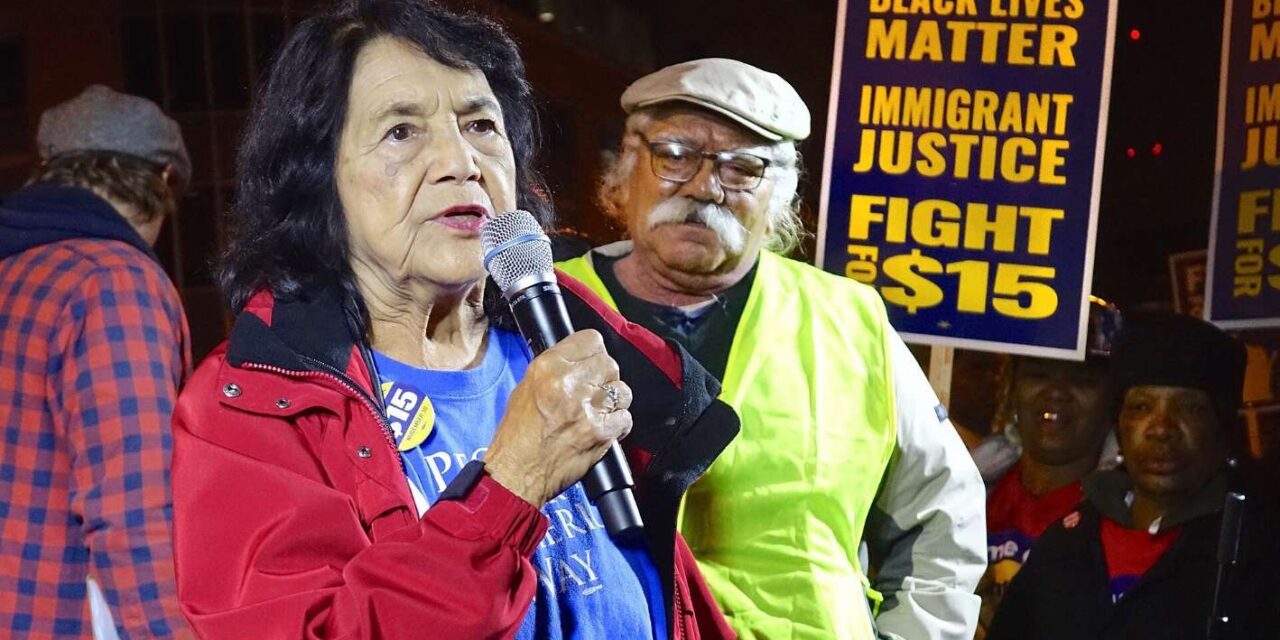
Huerta, whose relentless organizing transformed American labor and civil rights, died Oct. 28 of cancer at her Bakersfield home, surrounded by family. She was 96.
Her passing prompted an outpouring of grief, gratitude and renewed determination to continue her work.
Gov. Gavin Newsom ordered state flags flown at half-staff in her honor and announced Oct. 30 that California’s new Labor and Workforce Development Agency Building in Sacramento would bear Huerta’s name. Opened in January, the building houses approximately 2,500 state employees.
“Dolores represented the best of us,” Newsom and First Partner Jennifer Siebel Newsom said in a joint statement. “She was more than an inspiration — though she never stopped inspiring us — she was a dear friend.”
Born April 10, 1930, in Dawson, New Mexico, and raised in Stockton, Huerta began her career teaching children whose farmworker families struggled with poverty. She left the classroom to confront the conditions responsible for their suffering.
In 1962, she and César Chávez founded the National Farm Workers Association, a predecessor of the United Farm Workers. Huerta helped organize the historic Delano grape strike, directed nationwide boycotts and negotiated landmark contracts improving wages, benefits and workplace protections.
Her advocacy helped secure California’s Agricultural Labor Relations Act of 1975, which established collective bargaining rights for farmworkers. She also fought for disability benefits, immigrant protections, voting rights, women’s equality and safeguards against dangerous pesticides.
Her rallying cry, “Sí, se puede,” meaning “Yes, we can,” became a declaration of possibility far beyond the fields. She founded the Dolores Huerta Foundation in Bakersfield to cultivate grassroots leadership and expand civic participation.
Her honors included induction into the National Women’s Hall of Fame in 1993, the California Hall of Fame in 2013 and the U.S. Department of Labor Hall of Honor in 2012. President Barack Obama awarded her the Presidential Medal of Freedom in 2012.
California Secretary of State Shirley N. Weber remembered a cherished friend who understood that change demanded participation.
“Dolores understood that progress isn’t born from wishing for a better world, but from showing up, standing together, organizing, and making our voices heard at the ballot box,” Weber said.
State Controller Malia M. Cohen praised Huerta’s determination to secure dignity for working families.
“She organized, she persisted, and she opened doors for generations of women and leaders.”
For Sen. Lola Smallwood-Cuevas (D-Los Angeles) the loss was deeply personal. Calling Huerta a friend and mentor, she said, “Dolores didn’t just talk about justice. She put her life on the line for it.”
Assemblymember Isaac Bryan (D-Ladera Heights) reflected on her influence across generations.
“The news of her passing has been especially heavy for those of us who have been shaped by her leadership,” said Bryan.
Assemblymember Corey Jackson (D-Moreno Valley) also joined the tributes to a leader whose example connected labor organizing with broader struggles for equality.
“Her legacy reminds us that justice is not something we simply inherit. It is something we must build, defend, and pass on to future generations,” Jackson wrote on Facebook.
“We honor Dolores by continuing her work, standing with working families, building solidarity between communities, and ensuring every person is treated with dignity and respect,” continued Jackson. “California is better because of her courage and commitment. May we carry forward her vision of a more just future for generations to come.”
Huerta’s courage was tested repeatedly. Arrested during nonviolent demonstrations and seriously injured during a 1988 protest in San Francisco, she returned to organizing. Even in her 90s, she remained engaged in campaigns for economic and social justice.
Huerta broke decades of silence earlier this year, publicly alleging that United Farm Workers co-founder César Chávez sexually abused her in the 1960s and fathered two of her children. Her revelations sparked renewed scrutiny of Chávez’s legacy and prompted efforts across California to remove his name from public buildings and institutions. Huerta condemned Chávez’s actions and urged communities to honor the broader farmworker movement rather than one individual, as California institutions began renaming buildings, streets and other landmarks bearing his name.
Her family plans a private funeral, according to a family spokesperson cited by Bakersfield television station KERO. A public memorial is also planned, but its date, location and other arrangements have not been announced. The family has requested privacy and requested donations to the Dolores Huerta Foundation instead of flowers.
The California Association of African American Superintendents and Administrators (CAAASA), a longtime partner of Huerta’s foundation, captured that enduring responsibility in its tribute.
“She taught us that organizing is not just an action, but a way of life, and her legacy of ‘Sí, se puede’ will continue to echo in the halls of our schools and the hearts of our students for generations to come,” CAAASA’s statement read.
Support 82 years of Black Bay Area journalism. Every story, editorial and Community Voice piece — $20 a year.